Crust & Bloom
Half-Milk White Sandwich Loaf
crustbloom.com/bread/milk-white-sandwich-loaf
Scale & weigh the formula
Recomputes every weight. Tap a row to check it off as you weigh.
| Weighed | Ingredient | Weight | Baker's % |
|---|---|---|---|
| Bread flour | 900g | 100% | |
| Whole milk | 300g | 33% | |
| Water | 300g | 33% | |
| Starter (active) | 180g | 20% | |
| Unsalted butter, softened | 54g | 6% | |
| Sugar | 36g | 4% | |
| Fine sea salt | 18g | 2% | |
| Total doughAbout 2 loaves | ≈ 1,788 g |
Not every loaf has to be an open-crumbed boule with an ear. Sometimes you just want a slice of bread that fits in the toaster, holds a sandwich together, and stays soft for days. This is that loaf.
The one change from a plain white pan loaf is the liquid: half milk, half water. The milk softens the crumb, browns the crust to a deeper gold, and adds a gentle sweetness. The water keeps it from tasting too rich and gives the loaf a bit more structure than an all-milk dough.
The Formula#
This makes two loaves in 9×5-inch pans.
| Ingredient | Weight | Baker's % |
|---|---|---|
| Bread flour | 900g | 100% |
| Whole milk | 300g | 33% |
| Water | 300g | 33% |
| Starter (active) | 180g | 20% |
| Unsalted butter, softened | 54g | 6% |
| Sugar | 36g | 4% |
| Fine sea salt | 18g | 2% |
Mixing#
Warm the milk to just above room temperature so it doesn't chill the dough. Combine the flour, milk, water, starter, and sugar until no dry flour remains, then rest for 30 minutes.
Add the salt and work it in, then add the butter a piece at a time, squeezing and folding until the dough absorbs it. It will look greasy and torn at first and then come back together smooth and shiny. Knead or slap-and-fold for a few minutes until the dough passes a rough windowpane.
Bulk Fermentation#
Ferment at around 76°F (24°C) for about 5 hours, with 3 sets of stretch and folds in the first 90 minutes. The milk, butter, and sugar slow things down slightly compared with a lean dough, so look for roughly a 75% rise and a domed, airy surface rather than going by the clock.
Shaping#
Divide the dough in half (about 890g each) and pre-shape into loose rounds. Rest 20 minutes.
Pat each piece into a rectangle about as wide as your pan is long, then roll it up tightly from the short side, pinching the seam closed. Set it seam-side down in a buttered 9×5-inch pan.
Pan Proof#
Cover and proof at room temperature for 2 to 3 hours, until the dough crowns about an inch above the rim of the pan and springs back slowly when poked.
Baking#
Bake at 375°F (190°C) for 35 to 40 minutes, until the tops are deep golden and the internal temperature reads about 195°F (90°C). Turn the loaves out of the pans straight away and cool them on a rack so the sides don't steam and go soft.
Wait at least an hour before slicing. Soft loaves are especially prone to gumminess if you cut them warm.
Notes#
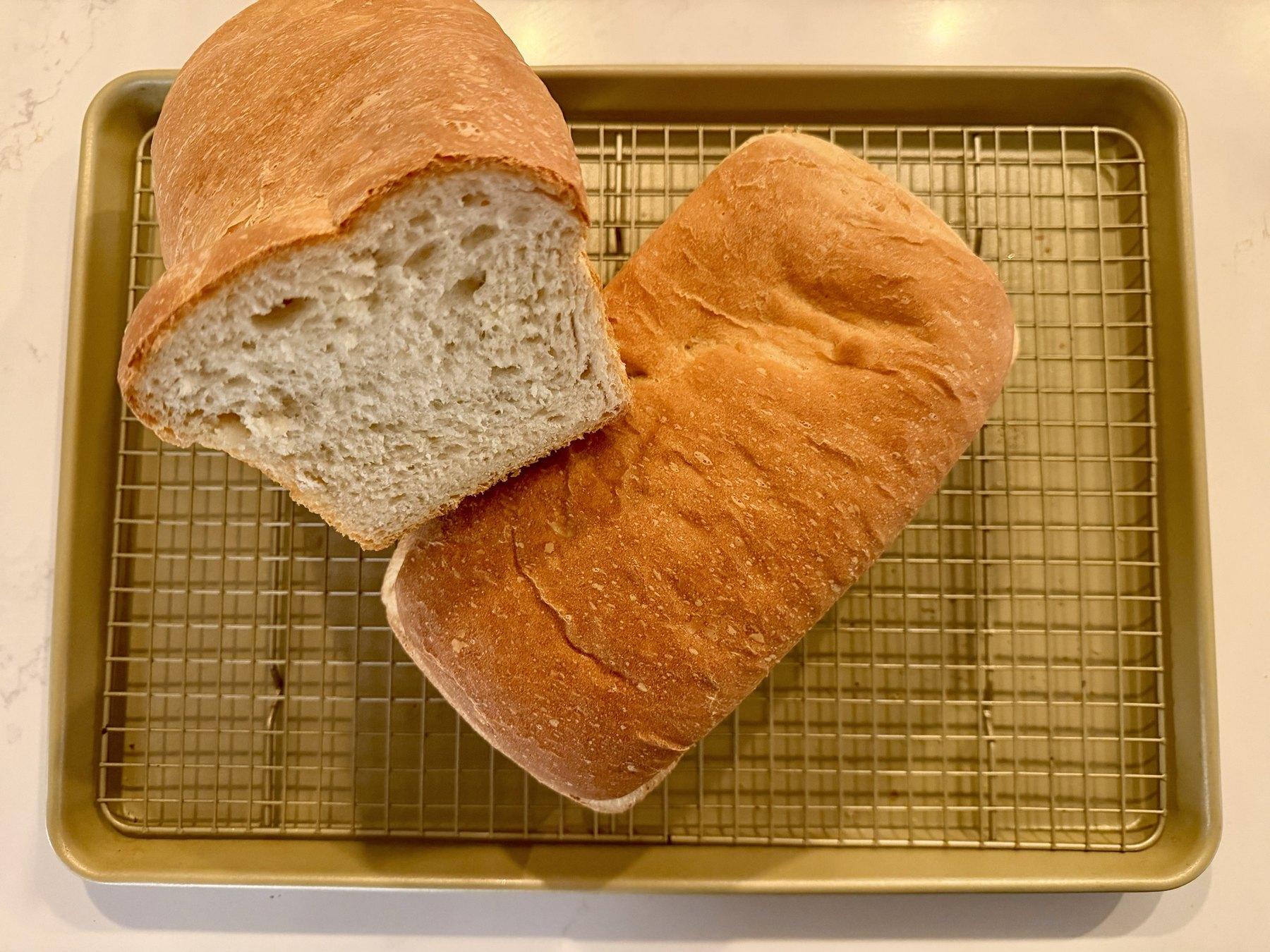
The crumb is close and even, with the odd larger hole, which is exactly what you want in a sandwich loaf: nothing falls through. The sides pick up the faint ridges of the pan, and the top crust is thin and a little blistered from the milk sugars.
Stored in a bag at room temperature it stays soft for three or four days, and it freezes well sliced. It makes very good toast and an even better grilled cheese.
Photos
Tasting Notes
A thin, golden, slightly blistered crust over a soft, fine, pillowy crumb with a few bigger pockets. Mild and gently sweet from the milk, with only the faintest tang. It tears in feathery strands and toasts to an even, buttery brown.